Audio Academy awards fellowships to Phillips, Sofos and Khatkar









Titrafilm, a French post-production company founded in 1933 and known for its early work in film subtitling, has expanded its Paris operations with two new facilities built around networked audio workflows and a standardized monitoring approach based on Genelec loudspeakers.
The expansion reflects a shift in the company’s workload toward immersive formats. According to Titrafilm, nearly half of its current projects involve Dolby Atmos, prompting the company to design new rooms that support multiple monitoring configurations while maintaining consistency across its facilities.
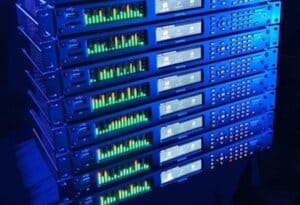
The audio systems were designed under the direction of Miguel Adélise, Titrafilm’s audio CTO. The company has long adopted an audio-over-IP infrastructure, which it says reduces cabling, lowers energy consumption, and simplifies duplicating technical setups across rooms. That networked approach proved particularly valuable during the COVID-19 pandemic, when engineers were able to continue recording and operating remotely using the existing infrastructure.
Titrafilm’s main operational hub is in Saint-Ouen-sur-Seine, just north of Paris. The site spans nine interconnected buildings linked via fiber and RJ45 networking and supported by three central machine rooms. The development of the studio infrastructure was closely associated with Pierre Frilley, a major figure in French film production and a key figure in Titrafilm’s history, who died last year at 87.
Two additional sites in Paris now extend the company’s post-production capabilities. One facility includes two mix studios, an ADR studio, 10 sound edit suites, 10 picture edit suites and a grading room. A second site adds 27 picture editing suites. All rooms use Genelec monitoring as a standard reference system.

Atmos-ready monitoring
Across the facilities, the monitoring systems support a range of configurations, including stereo, LCR, 5.1, 7.1.4 and theatrical Dolby Atmos setups using up to 38 loudspeakers. In the newest Atmos mix rooms, Genelec 1032C monitors are used for the LCR channels, while 8340A monitors handle the surround positions. Ceiling channels use Genelec 4430A Smart IP PoE models, allowing signal, power and control to be delivered over a single network cable.
Titrafilm says Smart IP loudspeakers are already widely used across the company’s other rooms, reflecting its broader commitment to network-based production infrastructure. Because the 4430A is the largest Smart IP model currently available, these units are used primarily for overhead channels in the Atmos rooms.
Elsewhere in the facility, some edit suites use RAW aluminium Genelec monitors alongside 7060B subwoofers. The systems combine traditional studio monitoring with Dante-based network connectivity. Adélise worked on the design of the audio systems in collaboration with system integrator CTM Solutions and Genelec’s French distributor Audio-Technica France.

Consistent monitoring across rooms
The company says it aimed to create consistent monitoring across every production space so that mixes translate reliably between rooms. “Everyone knows Genelec and knows exactly what to expect,” Adélise said. “We needed a system that was simple, reliable, scalable, well-documented and made sense financially. Genelec ticked every box.”
Some older Genelec models are still in use alongside newer installations. “We’ve still got original 1030s and 1032s that our engineers love working with,” Adélise said. “The 1030s still sound fantastic, and the new generation of 1032C smart active monitors with onboard DSP are just the right size for our new studios. The feedback from those rooms has been excellent.”
Titrafilm uses Genelec Loudspeaker Manager software for calibration where appropriate, although engineers still make manual adjustments during setup. “It’s effective and quick to set up, but we still like to make a few manual tweaks afterwards,” Adélise said. “There are no more endless debates about how things sound — we know the Genelec sound, and we can just get on with the work.”
All new rooms are pre-wired for Atmos, allowing the company to expand immersive capabilities without major structural changes. “Our network means we never have to rip the building apart to make changes,” Adélise said. According to the company, this flexibility will support future projects that may include Foley recording, music production and secure remote contributions for broadcast, podcasts and live events.
Adélise has recently transitioned to a new role as audio pro and post-production CTO at 44.1, the audio division of CTM Solutions. Because CTM Solutions was the integrator responsible for the Titrafilm installations, the move means the collaboration between the companies is expected to continue on future projects.
These stories might interest you
HMDK selects Genelec for control room