Genelec monitors support recording studios at Tallinn music academy








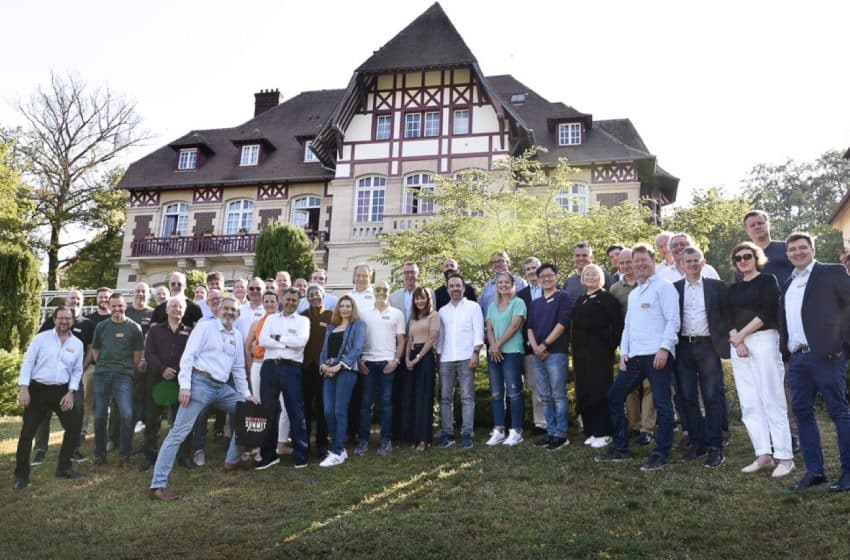

CHANTILLY, France — The 2023 RedTech Summit would always ruffle a few feathers, and that’s partly its point. When you bring together corporate heavyweights from mature markets, major players from emerging markets, leaders in game-changing technology and frontline innovators exploring tomorrow’s broadcast spaces, the stage is set for upending established perspectives. And that’s when strategic evolution takes leaps.
The secret of the RedTech Summit format is that the stage is fully interactive. There are no one-way sage-on-a-stage presentations. Every suggestion is open to challenge, and every challenge considered. Ideas are swapped, adapted and implemented with an eye on the next five-to-10 years because while the players in the room represent diverse components of the audio broadcast and digital audio sector, they share a commitment to the sector’s future.
Larry Rosin, president of Edison Research, set the context for the Summit, drawing on the vast insights from his company’s “Share of Ear” and “Infinite Dial” studies in the United States to show how audio consumption behavior is shifting. What became clear is that certain trends, such as the growth in mobile audio consumption, have a global footprint; in Rosin’s words, “The mobile phone is the machine that is eating listening.”
Other trends are region- and country-specific. This encouraged questions about why listener growth is rampant in some countries, such as those in Asia, while strained in others. It became clear that regulation in some countries — and corporate debt in the United States — could be stifling investment in innovation among, especially legacy, broadcasters.
Rosin’s context was both sobering and encouraging. In the U.S., for example, while listenership to linear radio is declining overall, people are still drawn to talk radio; music-format radio stations are largely taking the hit. The consensus in the room was that music still matters to people; but they are unwilling to wade through a 20 minute block of ads, insanely high repetition of songs and being told a song is new when it’s been played on TikTok for five months prior to its release on your radio station.
Those present left the Summit aware that the future of audio broadcasting is in their hands. It requires bold decisions and a willingness to embrace change
Life after linear
So, is there life after linear radio? That was the key question in the second session on Day 1 of the Summit, facilitated by Rüdiger Landgraf, chief digital officer for Kronehit, Austria’s biggest commercial radio station. He wasted no time putting those in the room on the back foot, demanding they each present the case for investing in linear radio. The arguments seemed sound but reserved and, in true RedTech Summit style, were then challenged. What did emerge was that there’s still something “cool” about radio, even among the youth. If you need any convincing, consider this: Spotify is using AI to create more “radio-like” experiences. (The secret was to rethink and reinvent radio but retain its “cool.” It’s one of the reasons Spotify is introducing a “personal D.J.”)
Kenny Ong, CEO of Radio Astro, explained how his group had reversed the listening ecosystem in Malaysia, where intermediaries such as Tune In attempted to disintermediate the program commercialization pathway. Astro has capitalized on the strength of its brand in a country where people are losing trust in online audio services to step in and become the intermediary, presenting listeners with multi-station offerings, including the BBC, on its platform.
Growing revenue
Growing revenue on linear and online/OTT audio was the theme of the first session after lunch on Day 1. Landgraf invited Jim Receveur, CEO of Bauer Media Denmark and Norway and Uroš Bogdanović, co-founder of Serbia-based Podmedia, to provide insights from their respective markets. What became clear was that different markets offer different opportunities. In mature markets like Scandinavia, young people produce podcasts but need ways to broaden their reach. Receveur encouraged stations looking to build their brands among the youth to reach out to these young podcasters. In emerging markets in Europe, such as Serbia and Montenegro, where regulations are still trying to adapt to changing listener trends, innovators in broadcast audio need to experiment with strategies. Bogdanović told how his company kicked off an FM station in Montenegro with one song, repeated.
Some of the most evolutionary approaches to growing revenue are emerging from developing markets. Prashant Panday, the outgoing CEO of Mirchi and Tapas Sen, its chief programming officer, explained how in a video consumption market encouraged by the heft of Bollywood and some of the cheapest data costs in the world, the group has leveraged strong access to the film industry to offer multimedia solutions. It has to — India is like Europe in one country, with multiple different markets. Mirchi has learned to mix it up — digital, audio and visual. “You need to mix it up,” said Panday. “The medium has changed,” added Sen, “but the fact we are creating content hasn’t.”
One of the key takeaway points from this session is that there is no one-size-fits-all approach to growing revenue and that radio is such a small part of any advertising pie; therefore, audio broadcasters can’t make more money from radio — they need to expand their offering and consider multimedia solutions for clients.
AI – threat or promise?
The day’s final session focused on how generative AI could change the game for audio broadcasting. Christian Schalt, chief digital officer for Germany’s RTL, pointed out that AI affects the whole value chain, from content creation, through production, promotion and marketing, to sales and distribution. He then examined each link and how generative AI could help broadcasters. Generative AI can speed up routine tasks and help creatives generate ideas, but its real power seems to be in sales. Tove Mylläri of YLE New Lab explained how Finland’s state broadcaster used AI to produce a cost-effective news service for Ukrainian refugees.
What became clear, and Zack Zalon, CEO of Super Hi-Fi, backed this up, was that AI will be available to everyone, so broadcasters need to ask how they will stand out. They must consider what talent they will need to get the most out of what AI can offer. Zalon said there were three steps to using AI for audio broadcasters: To ensure efficiency, as an onramp to providing an online service, and to provide a personalized service. He emphasized that AI remains a tool that requires human management, and if that management is innovative and efficient, AI can deliver on its promises. As an example, he finished by showing how to set up a radio station in less than 20 seconds.
Regulation – leveling the playing field
To creatives in audio broadcasting, regulation may lack AI’s luster, but for those making strategic decisions, it is one of the most contentious parts of broadcasting. This became clear when Dr. Christina Oelke, deputy legal counsel for Vaunet, the umbrella organization of audio and audiovisual media companies in Germany, kicked off Day 2. How the E.U. is squaring up to MegaTech was the primary focus of Dr. Oelke’s presentation, and those present were anxious to find out how the E.U. could level the playing field. Currently, 70% of all commercial revenue from online goes to the likes of Meta and Google. This is especially troubling given how radio advertising is declining, and agencies are pushing more sales online.
Another issue that emerged was how more countries, especially in Europe, are toying with advertising restrictions for legacy broadcasters around sugar-containing products, which wouldn’t affect online publishers. The E.U. is considering rolling out such restrictions, and, as Dr. Oelke pointed out, it’s difficult for broadcasters to find an argument against health. Their one option is to point out that without advertising, “the sector will be dead.” The secret to working with the E.U., said Receveur, is “to simplify what we want.”
Shifting workflows
Session 2 on Day 2 dealt with workflows. Quentin Howard, a consulting engineer for Boom Radio U.K., provided an excellent case study for decentralized workflows. The station, which targets the U.K.’s baby boomers via DAB+ and online, has no premises; presenters operate from their homes, and every component of the station’s operation runs through RCS in the cloud. With minimal overheads, it made a profit after its first year and is growing at 6% every month.
Dr. Lawrie Hallett, a senior lecturer in radio and audio at the U.K.’s University of Bedfordshire, helped steer the discussions and explained that shifting workflow models require re-examining staffing. A shift to data-driven operations will invariably require hiring young people who think digital-first.
Abe Thomas, CEO of India’s BIG FM network, explained how when Covid struck, the instinct was to cut costs, but he drew the line at staff. Instead, the network downsized offices and focused more on collaboration. The benefit of this de-siloed approach was that the network could better provide a portfolio of solutions for clients, which he described as “Radio and Radio+.” He encouraged broadcasters to shift their thinking from sales to solutions, and to ensure everyone, including programming, has targets.
Bridging silos and looking to the far future
This session segued easily into the next: Bridging the organizational silos between traditional linear and digital/online departments. Caroline Beasley, CEO of Beasley Broadcast Group in the U.S., explained how the group transitioned to a digital-first organization, admitting that it was not easy. “Now,” said Beasley, “every media plan involves digital.”
However, broadcast groups shouldn’t lose their focus on FM. In Malaysia, said Ong, taking away FM and concentrating on digital/online places a broadcaster firmly in the same space as Facebook and Google. He also pointed out that while online may be easier to measure impact for advertisers, few things beat them hearing their name on the radio. Much more needs to be done to ensure that radio operators are not trapped in old thinking as their audiences and advertisers change. Some compelling examples were shared from the floor on how operators have changed their models to adapt.
The RedTech Summit concluded with a look at new technologies and whether they are likely to fade away as a fad or whether they could have a meaningful impact on audio broadcasting tomorrow.
Finland’s state broadcaster has a dedicated hub — Yle Innovations — which explores and validates new opportunities in media. Satu Keto, innovation lead, joined her colleague Mylläri, to encourage those present to consider the cutting-edge technologies that may seem distant from radio but are waiting in the wings. These included Web 3.0, non-fungible tokens, synthetic characters and hyper-personalization.
Those present left the Summit aware that the future of audio broadcasting is in their hands. It requires bold decisions and a willingness to embrace change, experiment more and develop content natively for mobile phones and, where relevant, smart speakers to complement an FM focus.