

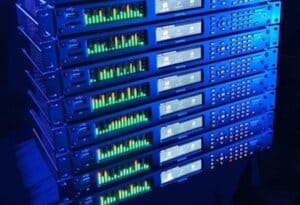







Norwegian digital media publisher and content producer Schibsted Media installed dhd.audio mixing consoles and signal processors for a dual-location production system used during the 2026 FIFA World Cup. The installation paired an RX2 console and XC3 core at Schibsted Media’s headquarters in central Oslo with a transportable remote system comprising a touchscreen TX2 mixer and XS3 core. Schibsted used the system to produce match buildup and second-screen coverage featuring reactions from experts watching the games.
“The DHD TX2 and XS3 core at the remote location are fully controllable via IP using the new RX2 at our HQ,” said Svein Tjeldflåt, an audio engineer with Schibsted Media Production Technology, the company’s in-house production engineering team. “That way we can have direct monitoring with effectively zero delay for the talents at the remote location. The system also allows us to make a local mix which can be sent without any latency to the public-address system at the remote location.”
The system works well and is very popular with our operators
Svein Tjeldflåt, audio engineer with Schibsted Media Production Technology
A VideoXLink encoder transported audio and video between the two locations and provided a secure Layer 2 virtual private network connection. The network carried control data for the DHD system and the video equipment, allowing a single technician to supervise the five-camera television production. DHD’s Assist application provided access for testing during system configuration. Schibsted also integrated DHD’s logic and output functions with Bitfocus Companion running on an Elgato Stream Deck, which operators used to control the audio system and other production equipment.
Presenters could select headset-monitoring modes, communicate over talkback and control audio routing. Muting a microphone from the on-air signal generated confirmation on both the TX2’s LED display and the Stream Deck. “The system works well and is very popular with our operators,” Tjeldflåt said.

The RX2 is a modular control surface that can accommodate systems ranging from six to 60 faders. Its motorized 100 mm faders, control modules and central touchscreen units can be arranged for different studio and outside-broadcast applications. Each console section incorporates a 10.1-inch touchscreen for functions including routing, equalization and dynamics control.
RX2 control surfaces connect to DHD’s XS3, XC3 or XD3 signal-processing cores over a single Ethernet cable. DHD Toolbox software allows engineers to configure the system from a connected computer. The compact TX2 can operate as a standalone mixer or extend a larger DHD installation. Measuring 25.8 cm wide and 27 cm deep, it combines a 10.1-inch capacitive touchscreen with two assignable potentiometers and six silent multicolor hardware buttons. Depending on the connected processing core, a single TX2 can control up to 96 faders, although typical configurations use between four and 12.
DHD Managing Director Marc Herrmann pointed to the networking capabilities demonstrated by the installation. “The ability to combine multiple DHD mixers into a single IP-connected network continues to be a major strength of our products, reinforced by the ability to provide fully secure supervision or hands-on control of networked DHD equipment between practically any two locations,” he said.
These stories might interest you
Rwanda’s public broadcaster embraces scalability to provide diverse output
Tech Focus: DHD RM1 Pro provides all-in-one portable audio production