







KUALA LUMPUR, Malaysia — During my 27-year engineering career, I’ve been exposed to various on-air radio consoles, invariably the trending digital consoles. Though at first glance, these look cool in the radio studio, configuring them can be challenging.
The team I am part of needs to connect a keyboard, mouse and computer screen to the live console. This may sound straightforward, but it can be cumbersome and time-consuming. Throughout my journey we have encountered numerous challenges.
One main issue is the complex configuration processes needed to operate these consoles optimally. It leads to confusion and frustration when troubleshooting possible problems during emergencies or live broadcasts.
The console architecture is often so rigid that a console struggles to meet the demands of the announcers, and we must change our workflow to meet most broadcasting scenarios. This modification requires us to change radio console modules. As technology evolves, some radio stations cannot meet their announcers’ requirements.
Despite these challenges our experience with traditional consoles provided valuable insights into engineering principles and system architecture. We also learned resilience, problem-solving and adaptability in overcoming obstacles and driving innovation. As the industry has evolved and traditional consoles became obsolete, a need emerged for more efficient solutions. So, we explored alternative technologies, which led us to faderless consoles (also known as virtual consoles) — a game-changing innovation that promises a superior user experience and enhanced functionality.
Technological advancements
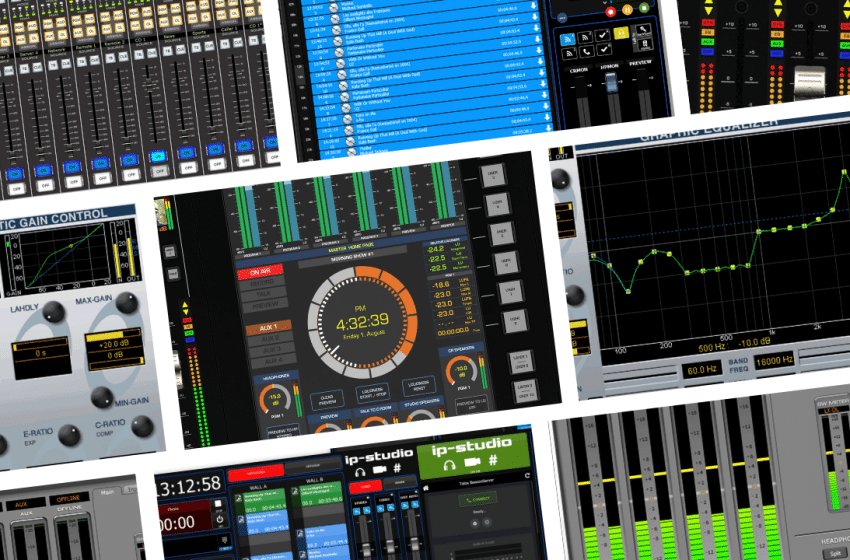
Radio broadcasting is a rapidly evolving realm where technological advancements continually redefine the production and dissemination of content. Introducing faderless consoles was a ground-breaking innovation that has reshaped the radio industry over the past decade. These avant-garde consoles eschew physical faders in favor of touchscreen interfaces and sophisticated software algorithms, allowing audio engineers unprecedented control and flexibility.
Unlike traditional consoles, faderless consoles possess a sleek interface that streamlines workflow processes and eliminates the need for external peripherals. With just a click, announcers or engineers can access the entire signal flow and troubleshoot issues, thus reducing downtime and operational inefficiencies. In addition, their modular design offers scalability and adaptability, ensuring seamless integration with the existing systems and futureproofing against technological advancements.
Shifting to faderless solutions marked a remarkable turning point in radio studio operations, allowing us to overcome the limitations of traditional hardware technology and embrace innovation. While our journey with traditional consoles presented challenges, it was a steppingstone toward modern solutions. By embracing innovation and leveraging technology advancements, engineers can confidently navigate the intricacies of the broadcasting landscape, ensuring continued success and growth in an ever-changing industry.
Despite the remarkable advantages faderless consoles offer, after extensive discussions with broadcasters, we’ve learned that some individuals hesitate to transition to them.
Navigating the transition
Despite the remarkable advantages faderless consoles offer, after extensive discussions with broadcasters, we’ve learned that some individuals hesitate to transition to them. Here are the typical reasons given:
- Investment in existing infrastructure — shifting to faderless consoles often requires significant investment in new equipment and technology. Some broadcasters are worried about the initial costs of purchasing and implementing faderless consoles, especially if they have already invested heavily in traditional console systems.
- Comfort with traditional consoles — many engineers and broadcasting professionals are familiar with the layout and functionality of traditional consoles, making them reluctant to switch to an unfamiliar system.
- Training and learning curve — faderless consoles invariably require additional training and relearning for engineers and staff used to traditional consoles, which is considered time-consuming and disruptive towards daily operations.
- Assumed risk of technology failure — concerns arise regarding the reliability and robustness of faderless console technology, which is heavily reliant upon software and touchscreens — prompting questions of potential technical issues, system failure or compatibility that may disrupt operations.
- Resistance to change — this is a common human trait, and many engineers or station owners may simply be resistant or reluctant to adopt new ideas or technology trends. This could be the fear of the unknown, or they don’t want to mess with existing processes established by their superiors in the past.
- The system integrator — broadcasters often turn to system integrators or their preferred vendor to provide integrated solutions for their operational needs. However, in most cases, without the involvement of the stakeholders, a system integrator may prioritize the brands they sell rather than the latest technology trends and what they are exposed to.
Advantages of faderless consoles
So, what distinguishes faderless consoles, and why are they gaining momentum among radio broadcasters? Let’s explore their defining features and advantages:
- Customizable layouts — unlike traditional consoles with fixed layouts, faderless consoles offer customizable layouts that can be tailored to suit announcers’ specific preferences and requirements. This flexibility allows announcers to create personalized workspace configurations optimized for their show, ultimately enhancing productivity and creativity.
- Streamlined workflow — faderless consoles streamline the audio production process by eliminating the need for physical faders, knobs and buttons. With an intuitive touchscreen interface, announcers can seamlessly adjust audio levels to a precise level while applying sound effects and managing multiple audio sources with just a few taps and swipes (like on their smartphones). Hence, the learning curve becomes shorter.
- Enhanced control and precision — faderless consoles leverage advanced software algorithms to provide precise control over audio levels, dynamics and effects. With real-time visual feedback and granular control options, announcers can achieve optimal audio quality and consistency, ensuring a superior listening experience for listeners.
- Remote accessibility — in an era of remote work and distributed teams, faderless consoles offer seamless remote accessibility, enabling announcers to control studio operations from anywhere with an internet connection. Whether working from home or on the go, radio broadcasters can remotely access and manage studio equipment, ensuring uninterrupted broadcasting operations.
- Future-proof technology — as technology continues to evolve rapidly, faderless consoles represent a future-proof investment for radio broadcasters. With software-based architecture and regular software updates, these consoles can adapt to evolving industry standards and emerging technologies, ensuring long-term viability and scalability.
- Reduced maintenance costs — faderless consoles typically require less maintenance than traditional consoles with mechanical components. With fewer moving parts and software-based operation, these consoles are less prone to wear and tear, resulting in lower maintenance costs and extended lifespan.
- Seamless signal flow visualization. One of the primary benefits of utilizing a faderless console is the ease with which announcers or engineers can visualize and troubleshoot the entire signal flow with just a single click. This functionality empowers radio engineers to swiftly identify and address any issues during broadcast operations, minimizing downtime and optimizing workflow efficiency. By providing radio engineers with direct access to the signal flow within the console interface, faderless consoles eliminate the need to rely on third-party vendor assistance or a system integrator for troubleshooting purposes.
Conclusion
Faderless consoles are a quantum leap in the radio broadcasting arena. They provide exceptional flexibility and efficiency and empower engineers and announcers to elevate their creativity in supporting and operating radio stations.
Adopting faderless technology heavily relies on the leadership within the technology and content teams at radio stations. However, many radio stations hesitate to embark on this faderless journey due to uncertainty and heavy reliance on third-party vendors and system integrators.
This highlights the importance of informed decision-making and forward-thinking strategies to transition to faderless consoles within the broadcasting industry. We can swiftly overcome any challenges to transition through education and training, and radio broadcasters can then harness the full potential of the faderless console and continue driving innovation in the radio broadcasting arena.
The author is a radio engineering and technology consultant.
More console stories
Radio Katowice installs Solid State Logic Duality Fuse console
D&R upgrades Airence-USB console