


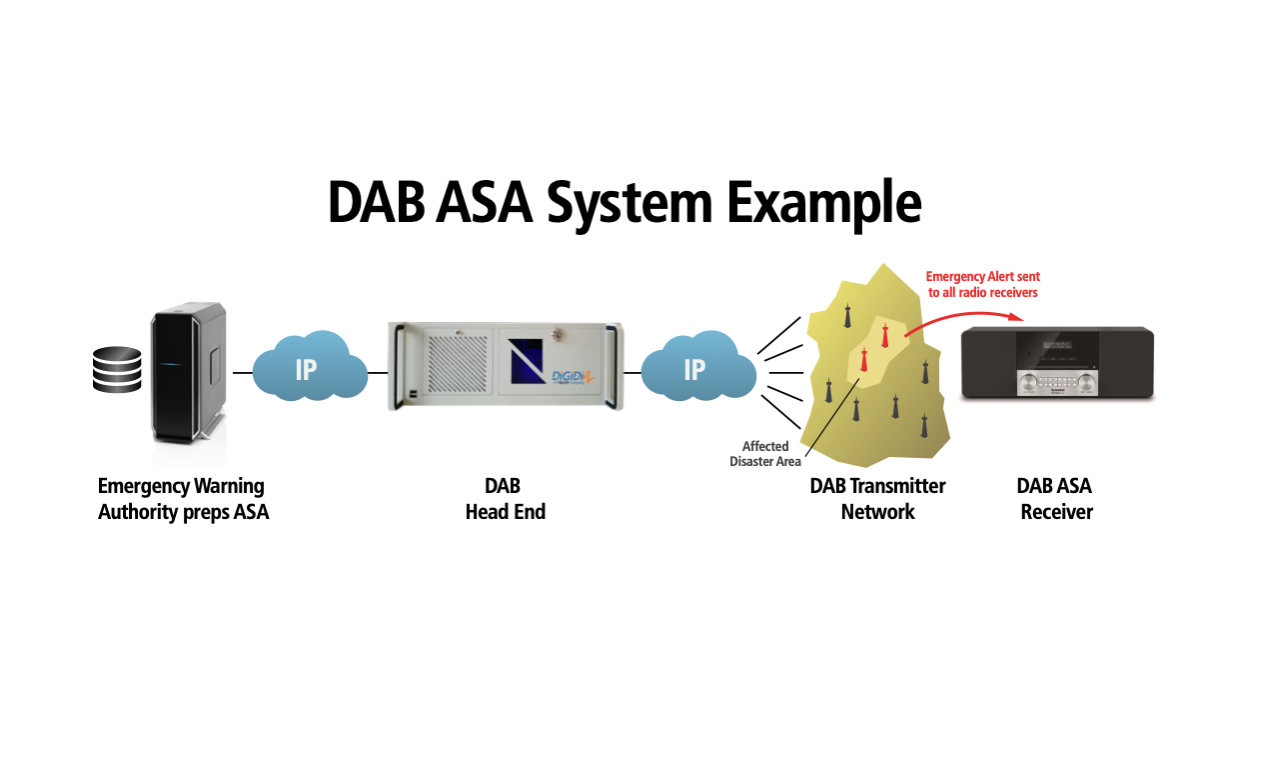


Alerting the public to regional or local safety emergencies has typically depended on 3GPP technologies, which require an internet or telecommunication connection; however, these methods have not always delivered the needed results.


With the introduction of Automatic Safety Alert in DAB, broadcasters have a powerful new tool independent of 3GPP to instantly inform the public of emergencies using the DAB VHF frequencies.
ASA allows emergency messages, e.g., sound and text, to override regular DAB programming to deliver urgent information without user intervention. With ASA, a receiver tuned to any service on any DAB ASA ensemble switches automatically to the designated emergency audio message.
This standard is designed for national, regional and local warnings, such as natural disasters, major accidents and security threats.
How it works
The mechanism for triggering an Automatic Safety Alert relies on signaling through the Fast Information Channel (FIC). The broadcaster may use an existing service or allocate a specific DAB subchannel with audio and text for safety alerts.
When an alert is triggered, receivers detect the signaling, check if the alert is relevant to the receiver’s location and, if so, “wake up” the receiver, instantly playing the emergency content.
The most important change is the ability to deliver emergency messages only in the alert area. A new locating coding system, specifically adapted to DAB, identifies specific regions down to a 1-square-kilometer resolution. This eliminates the delivery of alerts in areas where they are not relevant.
ASA receivers are all activated at the same time, and battery life is preserved through a one-minute duty cycle.
Multiple DAB ensembles are possible, and existing receivers will continue to work correctly.
What about the ASA receivers?
Receivers need to be able to decode the alerts and, at the same time, know their current location. This can be easily realized for car receivers with an interface to the car’s location system (primarily based on GPS). For home-based receivers there are two options. Models with Wi-Fi/Bluetooth can directly provide the location information, while more basic models have a menu for setting the location code that can be calculated with a dedicated app.
The sleep mode was designed to consume the minimum amount of power, involving only the RF front end and the receivers’ signaling decoders.
ASA receivers will be available off the shelf in the next few months and will be identified by an ASA logo. Certification by an independent lab is required.
By adopting this feature now, broadcasters can demonstrate leadership
in community protection and regulatory innovation.
Implementation steps for broadcasters
1. Verify headend infrastructure readiness
Broadcasters must ensure their DAB headend equipment supports ASA features, including:
- Dedicated menu for ASA settings and integration of the alert message
- Dynamic FIC updates
- Define the interface for transcoding the alert area, transmitted by the emergency authorities, to the ASA-specific location coding system. This part can be realized either in the DAB headend or in separate software.
- Transmit and synchronize information on the participating ensembles
2. Prepare alert content
The emergency audio will usually be created by the radio station responsible for providing the alerts generated by the emergency authorities in the particular country or region.
In some cases, the emergency authorities may create the message stream themselves. Whatever arrangement is agreed upon, audio and text messages will include the area affected, details of the incident, timeline and actions that the public should follow.
Options include:
- A live studio feed for alerts
- Prerecorded emergency loops
- Dynamic generation of messages based on templates
3. Configure the multiplex
Setting up ASA requires specific configuration of the multiplex:
- Establish the service that will carry the emergency audio messages
- Enable and test the appropriate signaling in the FIC tables
- Ensure quick activation paths (manual or API-based)
4. Receiver compliance testing
Successful operation depends on the receiver operating correctly. WorldDAB has established a receiver testing compliance scheme that allows manufacturers of DAB chips, modules and receivers to receive accreditation and the right to use the ASA logo on their products.
Broadcasters should coordinate with retailers and receiver manufacturers to ensure a ready supply of ASA-certified receivers and promote the public’s benefits of acquiring an ASA-certified product.
5. Deployment
Practical tips for a smooth deployment:
- Start with pilot tests — choose a limited area or one ensemble for the first deployment
- Keep it simple — initially use a single, clear audio message before implementing complex dynamic messages
- Monitor performance — integrate monitoring tools that log activation events and receiver behavior
- Plan for redundancy — ensure that fallback paths and backup content are ready if the primary system fails
ASA in DAB is not just a technical upgrade — it adds precious value to public safety. By adopting this feature now, broadcasters can demonstrate leadership in community protection and regulatory innovation.
Digidia’s latest DAB solutions fully support this feature, offering broadcasters an easy and robust path to integration.
The author is Nautel sales manager for Europe and Digidia head of sales and marketing.
This story originally appeared in the July/August 2025 edition of RedTech Magazine.
These stories might interest you
WorldDAB to explore DAB+ growth at IBC2025
Rohde & Schwarz delivers Flanders DAB+ network in under two months